The most common causes of increased fuel loss include low tire pressure, a dirty air filter, worn spark plugs, faulty sensors (MAF, ECT), and problems with the fuel system.
Sound familiar? You fill up your car about as often as usual, but suddenly notice that you’re not getting as far on a tank of fuel. Your route hasn’t changed, your driving style is the same, but your fuel consumption has increased.
Some fluctuations are normal. Traffic, temperature, speed, vehicle load, and driving style can all affect fuel consumption. But if the change persists, it’s worth finding out what’s causing it.
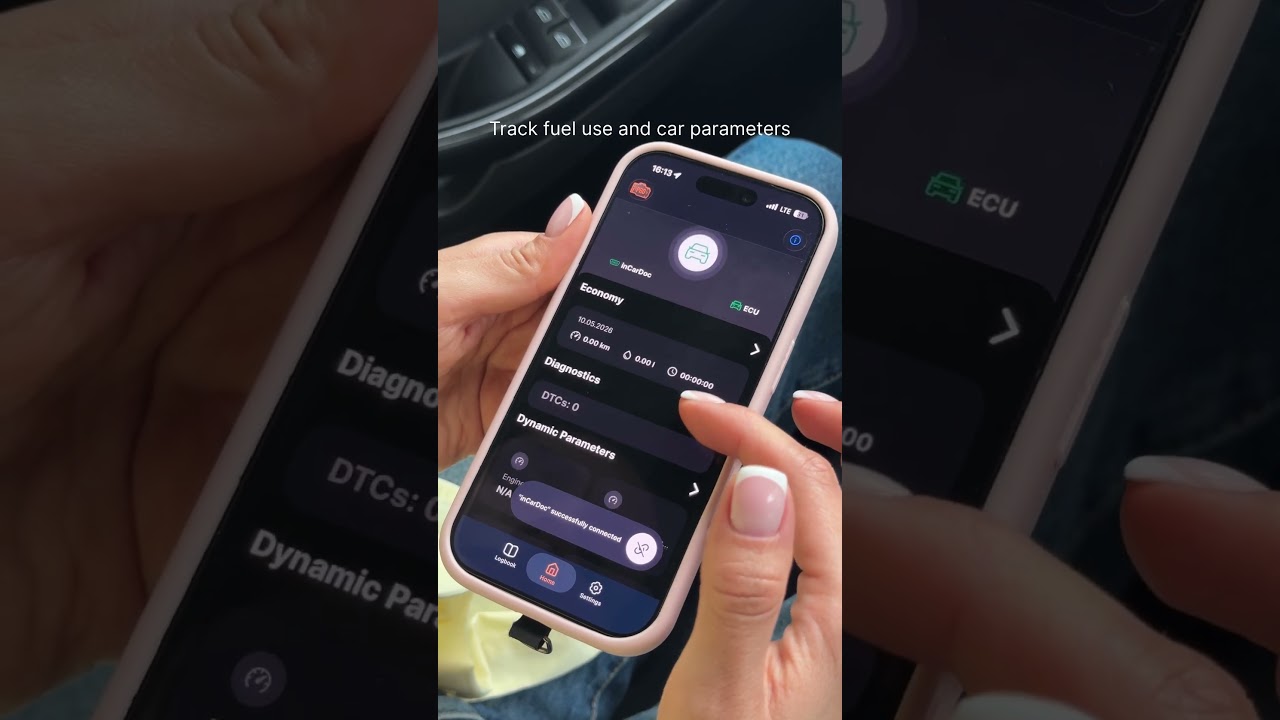
The first step is not to rely only on how the car feels, but to track its performance over time. For example, inCarDoc PRO includes the Economizer feature, which lets you monitor fuel economy during a trip. You can track both instant and average fuel consumption and see how the numbers change throughout your journey.
Why is my car suddenly using more fuel?
Common cause
Low tire pressure: Underinflated tires increase rolling resistance, so the engine needs more energy to keep the car moving. The first thing to check is your tire pressure and compare it with the vehicle manufacturer’s recommended level.
Common cause
Engine sensor problems: Modern cars rely on sensor data to manage engine operation. Incorrect readings, for example from the MAF sensor, can affect the fuel system. Some sensor-related issues can also trigger the Check Engine light and generate DTC codes. With inCarDoc, you can read these error codes.
Common MAF sensor error codes:
- P0100 – Malfunction in the mass air flow sensor circuit.
- P0101 – Mass Air Flow sensor signal out of range / performance problem.
- P0102 – Low Mass Air Flow sensor input signal.
- P0103 – High Mass Air Flow sensor input signal.
- P0104 – Intermittent signal in the Mass Air Flow sensor circuit.
Dirty air filter: the engine needs enough air to operate efficiently. If the air filter is heavily clogged, it can impact engine performance and fuel efficiency.
Worn spark plugs: In gasoline engines, faulty or worn spark plugs can cause misfires, rough engine operation, and reduced efficiency. DTC codes in the P0300–P03012 range can indicate this type of issue.
Engine temperature problems: A faulty thermostat or another issue with the cooling system can prevent the engine from operating at its optimal temperature. That’s why coolant temperature is one of the useful parameters to monitor. During OBD2 diagnostics, you may see codes such as P0115–P0118 (ECT sensor codes), P0217 (engine overheating), or P0128, one of the more common coolant temperature-related codes.
Fuel system concerns: Faulty fuel injectors or other issues with the fuel delivery system can also affect fuel consumption. If you notice a fuel smell or signs of a leak, have the vehicle inspected as soon as possible.
How do I know if my car is using more fuel?
Not every increase in fuel consumption means there’s something wrong with your car. More traffic, using the air conditioner, changes in temperature, or a different driving style can all affect fuel economy.
That’s why it’s useful to compare data throughout a trip instead of relying on a single number. inCarDoc PRO’s Economizer shows instant fuel consumption and its average value for the trip. The app also lets you record vehicle parameters in real time and view them on graphs.
For example, if you notice that fuel consumption suddenly increases at a certain point, you can compare it with other available dynamic parameters – such as speed, engine RPM, coolant temperature, and more.
OBD2 diagnostics can help find the problem
Monitoring fuel consumption is only part of the picture. If your numbers keep getting worse, it’s worth moving on to OBD2 diagnostics.
By connecting your car through a compatible OBD-II adapter, you can read diagnostic trouble codes (DTCs), check the Check Engine status, and monitor vehicle parameters in real time. You can also record the data for further analysis.
inCarDoc doesn’t just detect DTC codes. It also lets you clear them, perform advanced diagnostics, and save your diagnostic history, which can be useful when your car is serviced.
Finding a problem early can help you avoid more expensive repairs, unnecessary fuel costs, and premature wear of vehicle components.
inCarDoc helps you monitor your car not only when the Check Engine light is already on, but also during everyday driving. Download the app and start monitoring your car’s condition and fuel consumption today.
Monitor fuel consumption with inCarDoc
Track fuel economy, read DTCs, and monitor vehicle parameters from your phone.